Attendance System
 Access Control
 Door Security
 Turnstile & Entrance Control
 Security Inspection
 Parking Management
 Safety Products
 Software
 Other
Digital Student Academic Records Management | EBiddyaPro
October 20, 2026
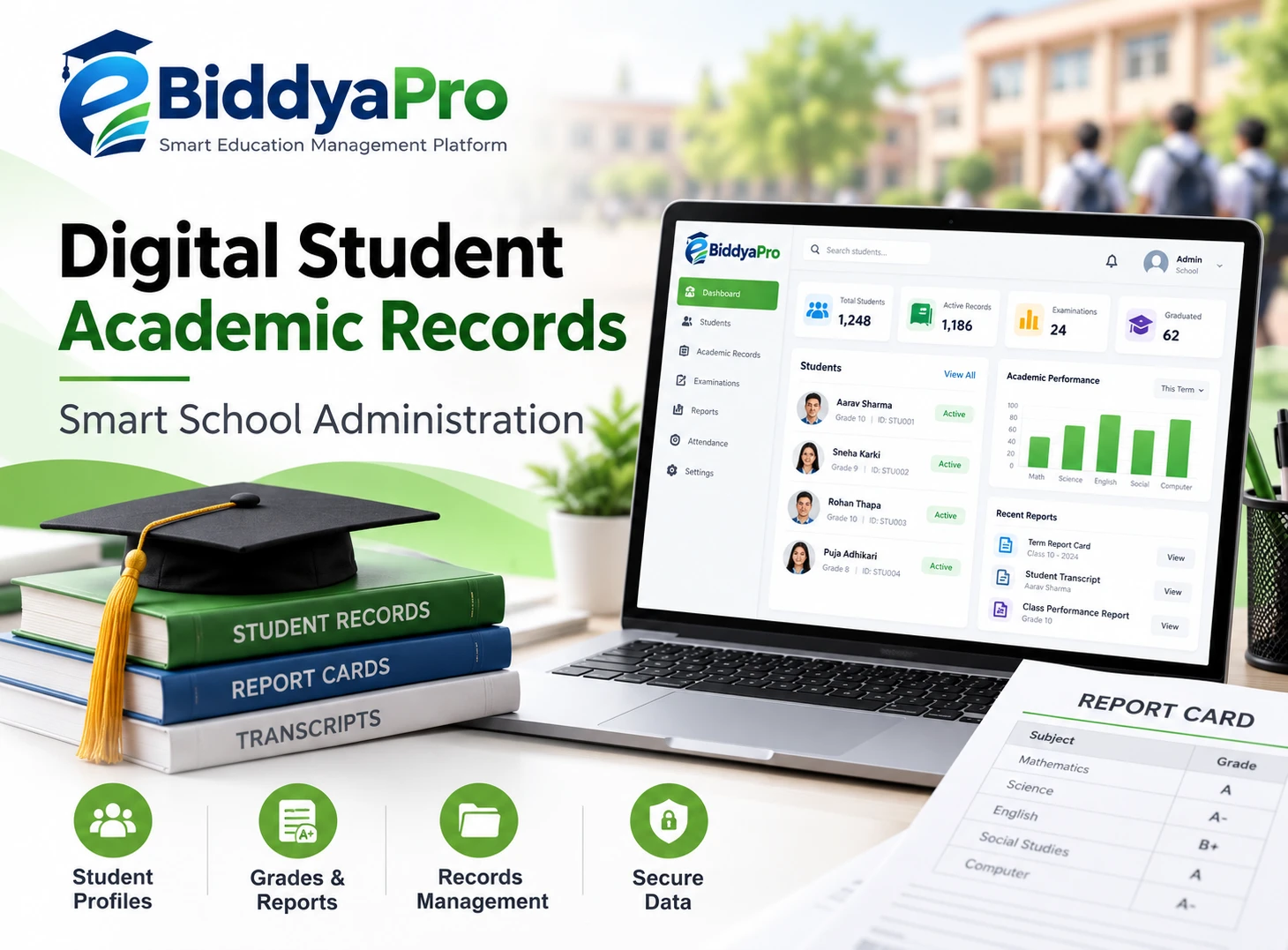
Digital Student Academic Records Management: How EBiddyaPro Simplifies School Administration
Introduction: The Future of Academic Record Management in Bangladesh
Educational institutions in Bangladesh are experiencing a growing need for organized, accessible, and reliable academic information. From student admission and class assignments to examinations, report cards, promotions, and academic transcripts, schools must maintain accurate records throughout each student's educational journey.
Traditionally, many schools have relied on paper registers, spreadsheets, physical files, and manually prepared examination reports. Although these methods are familiar, they can become increasingly difficult to manage as student enrollment and administrative responsibilities expand.
Missing documents, duplicate student profiles, calculation errors, delayed result publication, and difficulties retrieving historical records can affect school administration.
Digital Student Academic Records Management Software offers a structured solution to these challenges.
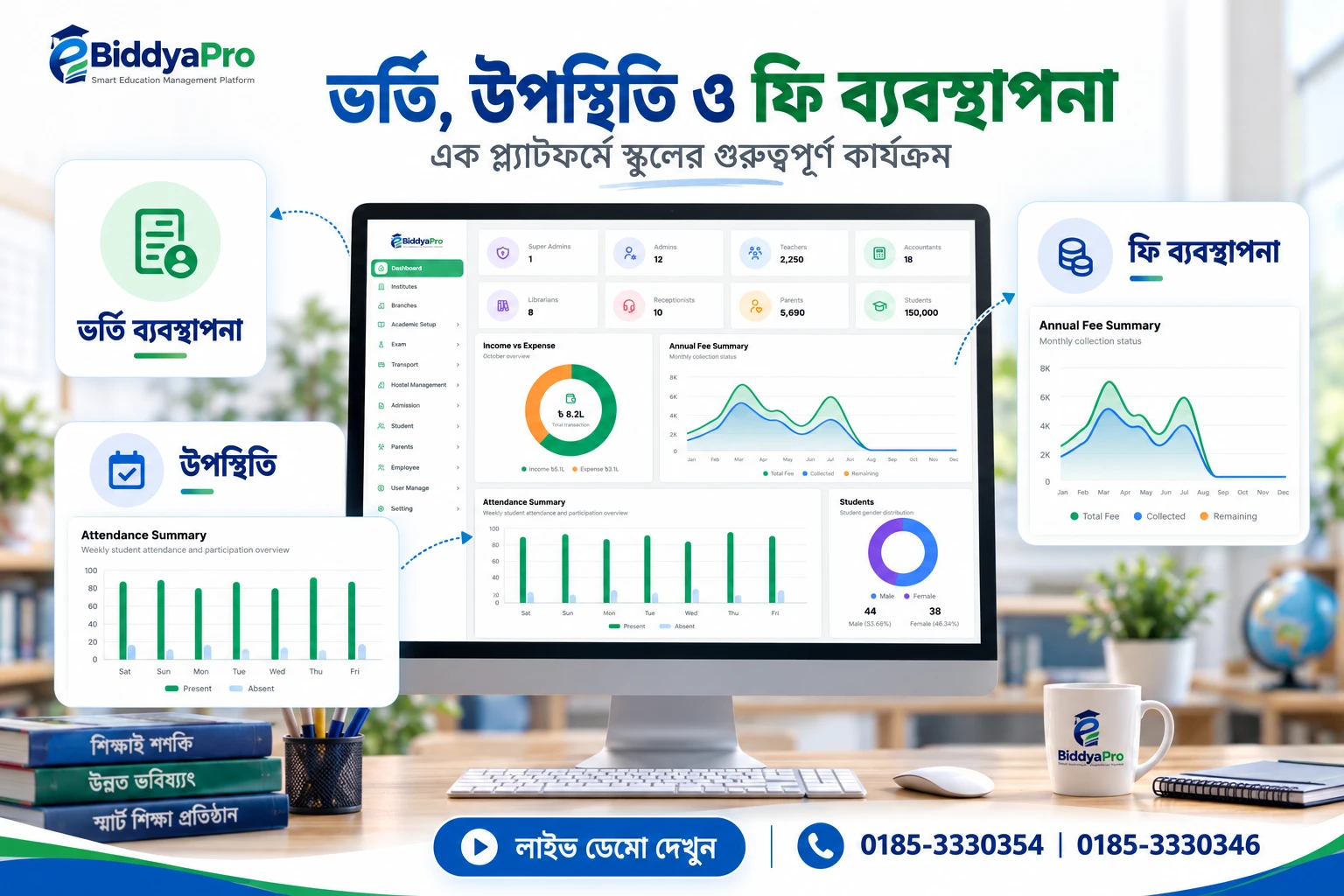
EBiddyaPro is a school management software platform designed to support academic and administrative activities, including student information, admission, attendance, examinations, results, academic setup, fees, and institutional communication.
This guide explains how digital academic records management works, its importance in Bangladesh, and how EBiddyaPro can help schools move toward more efficient, technology-enabled administration.
What Is Digital Student Academic Records Management?
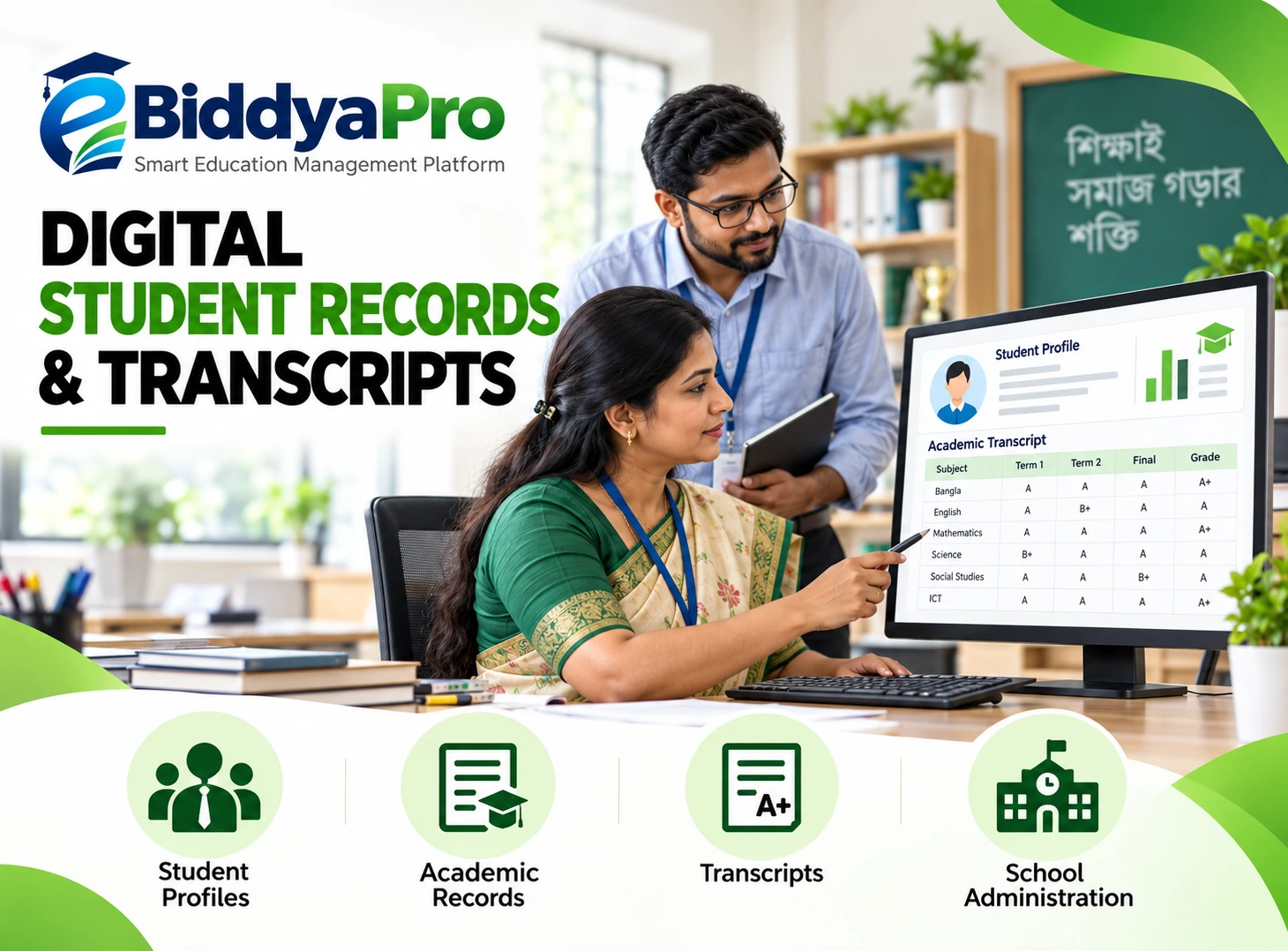
Digital Student Academic Records Management is the process of collecting, organizing, updating, securing, and retrieving student-related academic information through a computerized platform.
Instead of maintaining separate files for admissions, examinations, grades, and academic history, institutions can organize information within a centralized Student Information System (SIS).
A comprehensive student academic database may include:
Student identification and admission details
Class, section, and academic session
Student attendance records
Subject enrollment and academic assignments
Examination marks and grades
Term-wise and annual results
Report cards and progress reports
Promotion and class progression history
Transfer and transcript-related records
Academic performance summaries
The primary objective is to maintain consistent information that authorized teachers and administrators can use for academic decision-making.
A well-implemented system also reduces the need to repeatedly enter identical student details into different registers.
Why Digital Academic Records Matter in Bangladesh
Bangladesh has a large, diverse education system encompassing primary schools, secondary schools, school-and-college institutions, madrasahs, and other educational organizations.
The Bangladesh Bureau of Educational Information and Statistics (BANBEIS) publishes national education statistics and conducts institutional surveys to support educational planning.
Its Bangladesh Education Statistics 2024 publication and ongoing educational surveys highlight the importance of structured institutional information.
The Directorate of Secondary and Higher Education (DSHE) also operates an Education Management Information System, reflecting the broader adoption of digital information management in education administration.
These government initiatives do not mean that every school must use a particular commercial software platform. However, they demonstrate the importance of accurate, organized educational data.
For individual schools, digital records can improve administrative continuity, academic reporting, and communication with guardians.
Challenges of Traditional Student Record Management
1. Paper-Based Academic Files
Schools may maintain separate registers for admission, attendance, examinations, and academic promotion. Retrieving an older record can require searching multiple documents.
2. Duplicate Student Information
When student names, roll numbers, and class details are entered separately, inconsistencies may occur.
3. Manual Result Calculation
Preparing examination results manually involves collecting marks, calculating totals, applying grading rules, and preparing report cards. Repetitive calculations increase the risk of mistakes.
4. Difficulty Tracking Academic Progress
Without a centralized system, comparing student performance across terms or sessions can be time-consuming.
5. Delayed Report Preparation
Teachers and examination departments may spend significant time compiling class-wise results and preparing individual reports.
6. Limited Administrative Visibility
School principals may need to request separate reports from teachers or administrative personnel to understand academic performance.
7. Risks to Physical Documents
Paper records may be damaged, misplaced, or become difficult to retrieve over time.
Digital academic records management addresses many of these challenges through standardized data entry, structured storage, and controlled information access.
Introducing EBiddyaPro: Smart School Management Software
EBiddyaPro is an educational institution management platform designed to simplify academic and administrative operations.
Its wider functional scope includes student admission, attendance, fees, examinations, results, academic setup, routines, notices, staff management, payroll, accounting, and communication.
For academic records management, the most relevant areas are student profiles, class and section information, examination administration, and result processing.
By coordinating these functions, schools can establish a more organized approach to managing student information.
Specific features such as downloadable transcripts, historical result archives, customizable certificate templates, and automated approval workflows should be verified in the institution's selected EBiddyaPro plan.
Key Functions of Digital Student Academic Records Management
1. Centralized Student Information Database
A centralized database organizes essential student information in one structured environment.
Schools can maintain admission information, student identifiers, class assignments, academic sessions, and relevant administrative details.
This reduces dependence on multiple disconnected spreadsheets.
2. Student Admission and Registration Records
Student record management begins during admission.
Accurate registration information helps schools establish consistent student profiles that can be used throughout subsequent academic activities.
A standardized process also reduces duplication and administrative inconsistencies.
3. Class, Section, and Academic Session Management
Schools organize students by class, section, group, and academic year.
A structured academic setup helps administrators maintain accurate student assignments and prepare class-based reports.
This information also provides a foundation for examination planning.
4. Examination Management
Educational institutions conduct class tests, monthly assessments, half-yearly examinations, annual examinations, and other evaluations.
Digital examination management helps organize examination-related information, including subjects, assessment schedules, and marks.
EBiddyaPro's examination and result management scope is relevant to these workflows.
5. Student Marks and Grade Management
Accurate marks management is essential for fair academic evaluation.
A digital system can support structured entry and review of subject-wise marks.
When configured with appropriate assessment rules, it may also calculate totals, percentages, grades, or grade points.
Institutions should verify that the supported grading configuration matches their curriculum and assessment policy.
6. Digital Report Card Management
Report cards summarize student academic achievement during a particular examination or academic period.
A well-designed digital report card can present subject results, grading information, examination details, and student identification consistently.
Digital preparation reduces repetitive formatting work and helps schools standardize reporting.
7. Student Academic History
Academic history provides a record of a student's progress over successive academic sessions.
Maintaining this information helps schools review previous performance and prepare relevant institutional documents.
Long-term historical storage and retrieval should be evaluated during software selection.
8. Academic Transcript Management
An academic transcript is a structured record of academic achievement.
Depending on the institution, it may include subjects, marks, grades, grade points, academic session details, and certification information.
Digital transcript management can simplify preparing consistent academic records.
However, schools must distinguish internal academic reports from official board-issued documents. Commercial school software does not automatically have authority to issue or replace Bangladesh Education Board certificates or transcripts.
9. Attendance and Academic Coordination
Attendance is an important part of student administration.
Connecting attendance information with academic records can help teachers and school administrators understand attendance patterns alongside academic performance.
Such analysis should support students constructively rather than serve as an automatic judgment of their abilities.
10. Academic Reports and Management Information
School administrators need timely academic information to plan instructional support and review institutional performance.
Class-wise results, subject summaries, and examination reports can provide useful insights.
The availability of particular dashboards and analytical reports should be confirmed in the EBiddyaPro demonstration.
How Digital Transcript Management Works
A typical digital academic transcript workflow follows several stages.
Step 1: Student Identification
The administrator selects the correct student, academic session, and class.
Step 2: Academic Data Collection
Relevant examination and subject records are retrieved from the academic database.
Step 3: Marks Verification
Authorized teachers or examination personnel review marks for missing entries and errors.
Step 4: Grading Application
The institution's approved grading policy is applied to the relevant results.
Step 5: Document Preparation
A transcript or academic report is prepared using the institution's approved format.
Step 6: Authorization
The document is reviewed and authorized according to institutional policy.
Step 7: Distribution and Archiving
The institution provides the appropriate report and preserves an authorized record.
This represents a recommended workflow. The precise degree of automation available in EBiddyaPro must be verified.
Digital Academic Records and Bangladesh Education Boards
Bangladesh's education boards operate a web-based result publication system for public examinations.
The official service provides result-search options using information such as the examination, board, year, roll number, registration number, and institution EIIN.
This demonstrates how standardized identifiers support large-scale digital examination reporting.
However, an important distinction exists between school-level academic management and official board examinations.
School-level academic records include internal examinations, class assessments, report cards, student performance histories, and institutional academic documentation.
Board-level records include the official results, certificates, and transcripts issued or maintained by the relevant education authorities.
EBiddyaPro can be considered for organizing institutional academic information, but schools must continue to follow the official board's requirements for recognized examination documentation.
Applications in the Bangladesh Education Market
Private Primary and Secondary Schools
Private schools frequently manage admission, class assessment, attendance, fees, and report cards through small administrative teams.
A centralized platform helps coordinate these activities without maintaining separate records for each process.
English-Medium Schools
English-medium institutions may use different academic terms, assessment methods, and grading structures.
Before implementation, administrators should verify whether the software supports their curriculum and report formats.
School and College Institutions
Combined school-and-college institutions often manage several academic levels and large student populations.
Structured student information helps organize records across different classes and sessions.
Madrasah Educational Institutions
Madrasahs may follow different subject structures and examination requirements.
They should verify that academic configuration, subject management, and grading workflows support the applicable curriculum.
Multi-Campus Educational Organizations
Institutions with multiple campuses may benefit from consistent student information standards.
Campus-specific permissions and consolidated reporting capabilities should be tested before deployment.
Traditional School Records vs. Digital Academic Management
| Administrative Function | Traditional Method | Digital Approach |
|---|---|---|
| Student Registration | Paper forms | Structured digital profiles |
| Class Information | Separate registers | Centralized academic setup |
| Examination Marks | Manual spreadsheets | Organized marks entry |
| Result Calculation | Manual verification | Configured calculation tools |
| Report Cards | Manual formatting | Standardized preparation |
| Academic History | Archived paper files | Searchable digital records |
| Information Retrieval | Physical file search | Student-based lookup |
| Corrections | Handwritten amendments | Controlled digital updates |
| Academic Reporting | Manual compilation | Structured reports |
| Record Protection | Physical storage | Access-controlled digital storage |
These advantages depend on accurate configuration, reliable data, and appropriate user permissions.
Business and Administrative Benefits for Schools
Reduced Administrative Workload: Structured information reduces repeated data entry and manual consolidation.
Improved Record Accuracy: Standardized student identifiers and controlled updates help reduce inconsistencies.
Faster Academic Reporting: Organized examination information simplifies result preparation.
Better Institutional Continuity: Historical records remain easier to retrieve when properly archived.
Improved Parent Communication: Accurate academic records support clearer discussions of student progress.
Better Management Oversight: School leadership can review structured academic information for planning purposes.
Reduced Paper Dependency: Eligible records can be maintained electronically, reducing physical filing requirements.
Greater Scalability: A centralized platform can support expanding classes, sections, and student populations.
Software benefits should be evaluated through actual institutional workflows rather than assumed productivity percentages.
Student Data Privacy and Security
Student academic databases can contain personal information relating to children, guardians, and school personnel.
Schools should treat this information carefully and restrict access according to legitimate educational responsibilities.
Important considerations include secure user authentication, role-based permissions, data backups, controlled exports, auditability, and appropriate retention policies.
Schools must also consider Bangladesh's applicable data protection requirements and any special obligations concerning children's personal information.
Before choosing an academic management platform, institutions should ask where student information is hosted, who can access it, how backups are maintained, and what happens to records if the subscription ends.
Specific EBiddyaPro security implementations should be verified directly rather than assumed.
Implementing EBiddyaPro in a Bangladesh School
Successful academic digitalization requires careful preparation.
First, the school should review existing student registers, admission records, subject lists, examination structures, and grading policies.
Second, administrators should establish consistent student identifiers and remove duplicate or outdated information.
Third, the institution should configure academic sessions, classes, sections, and relevant examination settings.
Fourth, school personnel should test a limited academic workflow, such as preparing results for one class.
Fifth, teachers and examination administrators should receive practical training.
Finally, the school can expand implementation gradually while maintaining appropriate backups and record-verification procedures.
A pilot implementation helps identify configuration problems before institution-wide adoption.
How to Choose Academic Records Management Software
School owners and principals should assess solutions against their institution's academic requirements.
Important selection criteria include student profile management, curriculum flexibility, examination configuration, report formats, academic history, permission controls, security, support, and total operating cost.
Schools should request a live demonstration using sample examination records.
For EBiddyaPro, institutions should particularly verify transcript generation, historical result access, grade calculation rules, report card customization, and permitted data exports.
Why Consider EBiddyaPro?
EBiddyaPro offers a broader school administration framework beyond academic results alone.
Its student admission, attendance, examination, results, fees, academic setup, and administrative modules provide a foundation for coordinating institutional activities.
This makes it a relevant option for Bangladeshi schools seeking more organized student information and reduced dependence on disconnected manual processes.
The appropriate subscription plan and configuration should be selected according to the school's actual requirements.
Conclusion
Digital Student Academic Records Management is an important component of modern school administration.
Accurate student profiles, organized examination records, consistent report cards, and accessible academic histories help schools deliver more efficient administrative services.
For Bangladesh's educational institutions, digital academic management can support better record organization, improved reporting, and responsible long-term information management.
EBiddyaPro provides a school management framework through which institutions can coordinate academic records with essential administrative operations.
Schools seeking to modernize their systems should evaluate the available modules, verify academic requirements, and conduct a practical software demonstration.
Simplify School Administration with EBiddyaPro — Smart School Management Software for Modern Educational Institutions.
Frequently Asked Questions (FAQ)
1. What is Digital Student Academic Records Management?
It is the electronic organization and management of student profiles, examination records, grades, academic history, and related educational information.
2. What is EBiddyaPro?
EBiddyaPro is a school management software platform designed to support student admission, attendance, examinations, results, fees, and other academic and administrative functions.
3. Why do schools in Bangladesh need digital academic records?
Digital records help schools organize information, reduce repetitive paperwork, improve reporting, and retrieve historical student data more efficiently.
4. Can EBiddyaPro manage student information?
Student admission and information management are part of EBiddyaPro's functional scope. Specific profile fields and permissions should be verified.
5. Does EBiddyaPro support examination management?
Examination and result management are included within its described academic management scope.
6. What is Student Transcript Management Software?
It is software that helps educational institutions organize academic results and prepare structured academic transcripts or related reports.
7. Can EBiddyaPro generate academic transcripts automatically?
Transcript generation and its exact level of automation should be confirmed during a product demonstration.
8. What is the difference between a report card and an academic transcript?
A report card usually summarizes performance for a particular term, while a transcript provides a structured record of academic achievements over a defined period.
9. Can digital software replace official Education Board certificates?
No. Only authorized education authorities can issue official board certificates and related recognized documents.
10. Is EBiddyaPro suitable for private schools?
It is relevant to private schools seeking to organize admission, academic records, results, and administrative processes.
11. Can a school manage multiple academic sessions digitally?
A well-configured school management platform can organize records by academic session. EBiddyaPro's specific archival and session-management functionality should be verified.
12. How does academic records software reduce errors?
It helps standardize information, minimize duplicate data entry, and support structured verification of examination records.
13. Can teachers enter examination marks digitally?
Digital examination systems commonly support marks entry. The available teacher permissions and entry workflow should be checked in EBiddyaPro.
14. Can schools use different grading systems?
Many academic platforms support configurable grading. Schools should verify EBiddyaPro's compatibility with their curriculum and assessment rules.
15. Is student academic information secure in digital software?
Security depends on actual authentication, authorization, backup, hosting, and data protection controls.
16. Can guardians access student results online?
Parent access may be available through dedicated portals or communication features. The specific EBiddyaPro functionality should be confirmed.
17. Does digital academic management support attendance tracking?
Yes. Student attendance can be organized alongside other academic information when the relevant modules are configured.
18. Can EBiddyaPro support English-medium schools?
Suitability depends on supported academic structures, assessment rules, and report formats. A curriculum-specific demonstration is recommended.
19. Can madrasahs use school management software?
Yes, provided that the software supports their academic sessions, subjects, grading structure, and institutional requirements.
20. How can digital student records support school principals?
They make academic information easier to review, helping principals monitor results, organize administration, and plan improvements.
21. Can historical examination results be retrieved digitally?
Historical retrieval is possible when records have been stored and archived correctly. Retention and search functions should be verified.
22. Does EBiddyaPro integrate academic records with school fees?
Both academic and fee management fall within its broader scope. The exact integration workflow should be demonstrated.
23. How long does it take to implement academic records software?
Implementation depends on student numbers, record quality, academic configuration, staff readiness, and required integrations.
24. What should schools check before purchasing Student Records Management Software?
They should evaluate examination workflows, transcript formats, grading flexibility, data security, training, support, pricing, and historical data export options.
25. Why should Bangladeshi schools consider EBiddyaPro?
EBiddyaPro brings several academic and administrative functions into one school management environment, making it a relevant option for institutions seeking structured digital operations.
Transform Academic Administration with EBiddyaPro
Organize Student Records. Simplify Examination Management. Improve School Administration.
Discover how EBiddyaPro can support your institution's digital transformation through coordinated academic and administrative management.
Request an EBiddyaPro Product Demo Today.